A Crazy Thing Happened on my Way to Damascus

When I think I’ve got it bad, I remember Paul of Tarsus. I’ve had my opportunities to complain, but Paul always had it worse than me. Most theologians and historians agree that He was probably on the upper crust of the economic scale in the first century but then there was that Damascus road experience, when he met Jesus. Sounds great, but I’m sure it wasn’t all that thrilling that the first thing Paul ever heard from the Son of God would be, “Paul, why are you persecuting me?” It was a reality check. He’d spent his life as a religious zealot, only to find out that he was on the wrong team. And then he was blinded. He must have thought, now I know the truth but how do I find my stuff?

They charted his travels in the maps section of almost every Bible I own, but the maps are a reminder that Siri wasn’t available back then and he traveled by foot, or beast of burden or by ship. But the ship sank.  That’s bad. He survived. That’s good! But he got bit by a viper. That’s bad. But he miraculously survived. That’s good! 

He rode the roller coaster of a church planter like a cowboy on the back of a two-ton bronco. He was done wrong by a lot of friends, but he kept going. No doubt he was on Jerusalem’s 10 most wanted list and escaped out of a window in a basket, but he kept on going. He was beaten with rods three times, whipped 40 times minus one, five times. But he kept on going. He was left for dead, but like a cast member of a zombie apocalypse he got up and kept going. He sang in jails, wrote 28% of the New Testament, caused a ruckus in a market, and lulled a guy to sleep during one of his lectures, and somehow the guy fell out of a window, died, was resuscitated and Paul kept on going. He was the Hebrew version of the Energizer bunny. Oy vey!

Oh, and he made tents as a side-hustle. Just a little detail…

Onesiphorus, a contemporary of his day, described him as short, bow-legged, and bald, with a slightly hooked nose and a unibrow!  Is there any wonder he was single? He had a dual citizenship, but most of the time, he was a citizen of the road. His story falls into the category of riches to rags. He didn’t leave a lot of material wealth when his head was placed on the block, but I can hear him now as the Roman executioner led him to the place of his death, still making conversation: “Did I ever tell you this story? I was a rich, religious scholar. I had everything going for me. I was the cat’s pajamas. Little did I know something better was in store. A crazy thing happened on the way to Damascus.” 


You Will Never Mock People into Heaven

A friend of mine sent me a video yesterday that, at first, made me smile and then made me wince because I realized what kind of impact that it would have on my spiritually lost friends and family. The church can’t afford to be mockers at the expense of the next generation.

There are plenty of opportunities for believers to begin gospel conversations in the arena of social media. But at the same time, we might permanently lose the very people we intend to reach with the gospel. There’s really no place for mockery in the church even while we feel angry because of the current state of our culture. We aren’t the first generation to face the decay of society and to weep at the way our society is going. But every great movement of God happens because of connection, prayer and compassion. God never moves amidst our pride, and mockery.

In order to find connections, we must stop politicizing every issue and realize that there are people who are dying for truth. They are hoping for a deep level of compassion and empathy while we lean on our own moral platitudes and strike back with memes, links and parody videos. There is a deep and lasting desperation that we are called to address. There’s no way to overflow with love and mockery. These elements flow out of two separate spigots.

Our clever “gotcha moments” never send anyone to heaven. So today I mourn the state of the Church
and regret deeply that many have lost our compassion. We have turned to anger as a cathartic practice to make ourselves appear more righteous. We appear as social media warriors on paper horses throwing political grenades across the wall, looking to gain amens, likes and shares from our brothers and sisters who share the same axes that we grind. The dopamine is released in the pomposity of our supposedly regenerated minds while the rest of the world that we are called to reach, turns away from the Church because of our pharisaical posturing and ungodly hubris. There’s just no getting around the fact that we must do better as the Body of Christ.


The Overcommitted Deacon

5 Keys to Surviving the Storm

It had been an especially difficult year for our church. A number of key long-standing members abruptly left our church in protest to the changes we had incorporated in our schedule in the hopes of reaching new people. At our monthly deacon’s meeting, we were discussing the issue when Carl stood up, grabbed his coat and surrendered with a shocking declaration.  “I’m out. I’ve had enough of all this!” 

As his pastor, no one was more surprised that I was. What had led him to this sudden outburst? After the meeting I called and asked him to meet me at a coffee shop nearby. Well into the night, I listened to him share his story. Carl had bottomed out and had nothing more to give. The demands of a new baby, a wife with postpartum depression, teaching a small group, coaching his son’s soccer team and the constant care of his father in the late stages of Alzheimer’s had so wearied him that his despair was unmanageable. I wept with him and realized that I had completely failed to put the pieces of his story together. It was a stern reminder to me that we are all strugglers. The storms of circumstance and over-commitment can send the best of us to the brink. 

None of us are immune to the ravages of adversity. We all have stories of troubles that come in bunches mixed with the trap of over-commitment. This includes pastors, wives and all leaders. The choices we make will ultimately determine our success in surviving and thriving in the midst of a perfect storm. 

By the way, if you are in one of those seasons where everything is manageable, you might want to tear this article out and stick it in your pocket.  Chances are, you’re going to need it in the future.

These following five choices are lifesavers that you’ll need to have on board when you feel overwhelmed and overextended.

  • Connect

As men we often want to be that lone silent warrior holding everything together singlehandedly. Read this slowly: This is not biblical. There was a reason God created the church. The Bible implores us to connect and collaborate in a shared journey of discipleship. If you are struggling or feeling overwhelmed, tell someone. Phone a friend. Yes, pray. But pray with other men who will have your back and walk you through the fire. David, find your Jonathan. Moses, find your Aaron. Shadrach, find your Meshach and Abednego. Connect biblically, or you may be Samson looking for his Delilah and we know how that turned out! 

  • Condition

In other words, get moving. Make physical conditioning a part of your daily routine. Hit the gym. Take a walk. You might not feel like it when you are overwhelmed. If you get to the place where you are saying, “I just don’t have time to exercise,” then you probably need to more than ever. Keep the body working even when life isn’t working. Drink lots of water. Stay away from food that’s handed to you through your car window. Fast food will send you on the fast track to burnout. 

  • Clear

Prioritize the important responsibilities you have on your plate and clear the rest of it off your plate. I grew up believing that God was most pleased with me if I had more things to do than anyone else. In my forties, I had to create new nuero-pathways in my brain to fully accept that busyness is not next to godliness.

The following is NOT in the Bible.

Thus Jesus hurriedly got up realizing what an important day this was going to be. He ran to Galilee and there He created 13 lesson parchments, visited 15 lepers in one night. Exhausted, the disciples verily tried to keep up with the Son of God but nay, they could not. They marveled at his time management skills and his strength in persuasive skills. People flocked to him and stayed with him for they knew that if He could accomplish such management tasks with great haste, effort and fluidity that he knew the habits for being an effective person. 

Nope. It never happened.

For me, living a clear life means spending some time clearing off my desk so that I can think. It also means that I need to look critically at my calendar and begin to say the most difficult two letter word in the English language. “No”. I confess. I don’t like the way it sounds when it comes out of my mouth. Especially when I have to say it to someone I love and admire.  

Clear your schedule, clear your desk, and clear your mind. It’s truly amazing how simpler life becomes when your clear it up. 

  • Cool Down

Take time to recover from a difficult meeting, hospital visit or funeral. Don’t put tape over the dummy lights on your dashboard. If the pace of your life is overheating, take time to cool down. Start turning stuff off. Put your phone on silent mode and become mindful of what your body is saying to you. If you are overheating, you’ll get nowhere fast. 

  • Confess

I’m not referring to making a confession of your sins, although that’s a good thing we should constantly do. By confessing, I mean turning to God and confessing that you are weak. I used to believe the following statement was scripture:

“God will never give you more than you can handle.”

It’s not in there and it’s not true. God will often give us more than we can handle for the expressed purpose of showing us that we must confess our weakness. However, God will never give us more than He can handle. And that’s good news. 

So what happened with my deacon friend, Carl? Our amazing group of deacons rallied around him, and stood in the gap as he navigated through the storms and recalibrated his life. He learned that he didn’t have to do everything. He’s still serving today but this time with more focus and support. His prefect storm served as a reminder of God’s grace in our times of weakness and over-commitment. 


Disaster Relief from the Aftermath of Ian

https://youtu.be/qs0TQyRz8ZI

Yesterday I had an opportunity to go to Wauchula Florida and participate in disaster relief. This was a great opportunity to see faithful Tennessee Baptists serving.


I put my hand over my mouth

It’s something in the core of most people: a desire to find out what or who causes messes. And no one likes to get the blame for a mess. As children we blamed our brother or sister for the broken vase and when we’re older we blame our self-sworn enemies for the broken world. And it is broken. The world is a mess and many just can’t do mess.

Cal Jarrett, the father in the 1981 movie, “Ordinary People” said to his emotionally distant wife:

“We would have been alright, if there hadn’t been any mess. But you can’t handle mess. You need everything neat and easy. I don’t know. Maybe you can’t love anybody. It was so much Buck. When Buck died, it was as if you buried all your love with him, and I don’t understand that, I just don’t know, I don’t… maybe it wasn’t even Buck; maybe it was just you. Maybe, finally, it was the best of you that you buried. But, whatever it was… I don’t know who you are.”

I’ve heard many explanations at the graveside, where people tried to explain or theologize accidents, cancer, or covid. These philosophical expeditions are fool’s errands. Others don’t blame, they just disconnect.

We’ve lived through a season of blame. Some blame the mandates, immune systems, fake news, Facebook, critical race theory, politicians, presidents, doctors, the masked, the unmasked, antifa, news outlets, millennials, boomers, China, political parties, and mandates. Blaming is what we do to make ourselves feel better. We feel more in control when we have an enemy we can attach to the post office walls of our souls. But that feeling becomes eventually void, brief and ephemeral. We dig into our own feeble logic and construct belief systems that tie neat little bows over our limited and inadequate world view. Our nature is to forward blame to others so that we can feel better about ourselves and rationalize the root of anger that grows beyond the borders of our personal lives. This is Springsteen’s darkness on the edge of town. We live in the shadows and snipe at our enemies from Twitter accounts and snarky memes.

One thing is certain: Blame keeps us in safe little bubbles where we don’t have to engage. It works until we realize that the bubble is an eternally dangerous place to be. That bubble of isolation and stagnation leads to an insidious rot of the soul.

I’ve witnessed the birthing process. It’s messy. There’s pain, blood, sweat, snot, cries, and danger. I’ve also experienced graveyards. There’s organization, specific dates, symmetry, and nice, tidy rows. But, I’d rather be in the labor room. You learn so much more.

Throughout the book of Job, we see men doing postmortems of tragedies that come in bunches. We’ve all had cascades of crises which appear together out of nowhere. The baby is sick, the car blows up and we get passed over for the promotion- all in one day. It’s easy to ask the wrong questions when life gets dark and messy. The default is often, “Why?” “What did I do?”  Or, perhaps, an even more insidious question, “Why is God doing this to me?” More often than not, these questions are pointless.

The meaning of the book of Job is found late in the fourth quarter after all the armchair quarterbacking is completed. God finally speaks. A lot. Finally. God asks him 46 answerless questions about the mysteries of His purpose. 46! How would you like that divine interrogation? I can relate to Job’s response: “I am unworthy—how can I reply to you? I put my hand over my mouth.”

When God speaks all I can do is put my hand over my mouth.

When God speaks I get tired of my own opinions.

When God speaks I realize that maybe I should shut up about my theories for once.

When God speaks I realize that I’ll never understand the world on this side of eternity. 

I say like Job: I have spoken once, but I have no answer— twice, but I have nothing to add.”

It brings Job to a majestic response: Only God knows. His plans are much higher than my mind can fathom.

There’s a joy in not having to explain God, and simply trusting Him when troubles come in bunches. There’s serenity when you hand the gavel over to the Almighty Judge of the universe. You don’t understand? Well, guess what. You aren’t God. How can I add anything to what God has already decreed and ordered in the timeline of His sovereign grace?  I ask about injustice and He replies, “Go look at the elephant. I made that.” I worry about the future, and He tells me to look at the birds.

I give up.

I put my hand over my mouth.


The Empowered Life Workshop Notes

Todd Proctor, John Harrison and Kathleen Doyle

How do we order our lives? It has to be an inner journey.
It’s all about adoption. 
We are not earning a relationship. This is how evangelicals often mis the point.

This relationship with the Spirit is not something done to us, but with us.

When you grow, you will find me bigger.

Aslan, Aslan. Dear Aslan,” sobbed Lucy. “At last.”  
    The great beast rolled over on his side so that Lucy fell, half sitting and half lying between his front paws. He bent forward and just touched her nose with his tongue. His warm breath came all round her. She gazed up into the large wise face.  
    “‘Welcome, child,” he said.  
    “AsIan,” said Lucy, “you’re bigger.”  
    “That is because you are older, little one,” answered he.  
    “Not because you are?”  
    “I am not. But every year you grow, you will find me bigger.” 

C.S. Lewis, Prince Caspian: The Return to Narnia The Chronicles of Narnia (1951, this edition Harper Collins, 1994) 141. 

  • “In order to receive more of the Holy Spirit we need to have empty space to fill. This space we must create; it will not simply appear. “
  • We have to give ground over a period of time.  How do we become who we really are?
  • It’s contemplative practices.
  • Life in the Spirit informs our spiritual practices. The Bible supports Nuerplasticity. When we talk about contemplative life we are talking about something most of evangelicalism has abandoned. Part of this journey is the con template life.

Knowledge of self and God

  • When we only attempt to know God without knowing self, there is a lack of intimacy.
  • Who I am speaks into how I see God. Our view of God is a composite of our mother or father (bad news) We often look for passages that we already believe.
  • By not knowing myself I go back to scripture that reinforce rather than inform my knowledge of God. How many people have deconstructed their faith because their background had an imbalance;anced view of God.
  • We have to get to the place of radical honesty.
  • “I know you know the right answer but what is the real answer.”
  • God is saying, “Take me by the hand and let me show you who I am.”

Contemplation and Action

  • If I hate solitude and silence, when we do we begin to ask why.
  • It was performance and pressure. When I entered into silence I began to ask why.
  • Taking time out of business and getting to see what’s honestly going on in my soul.
  • Whatever it is will come out.
  • When we are not contemplative, we start to compare ourselves with other. It becomes the fuel, rather than God, himself.
  • If I am deeply connected with God we are no longer stuck in numbers and performance.
  • We become what we behold.

Resources:
The Gift of Being Yourself by David Benner
Invitation to a Journey by Ruth Haley Barton
Sacred Pathways by Gary Thomas
Practicing the Power by Sam Storms
Other Authors: James Bryan Smith, Richard Foster, Dallas Willard

Other Thoughts:

One other resource: PracticingTheWay.org

  • You think that slowing down will cost you, but in truth it will make you more productive. It will open you up to the capacity of God. It increases our ministry effectiveness.
  • You don’t have time, not to do this.
  • Sometimes the unpleasant stuff that bubbles up is the stuff that ultimately brings a breakthrough.


Set Your Mind to Work

The phone rang. It was Derrick. Again. He was the guy in our church that could turn a five-minute stand-up meeting into a full-on Wednesday night, 9 PM, filibuster! “I don’t think we should proceed with the church renovation. We really ought to crunch the numbers on the carpet before we spend the money. And I don’t like the contractor. I think he’s got his own agenda. I bet he’s not even a Christian. I know he came with solid recommendations from Jeff, John, and Bill but I really think we out to wait for a couple of months and see how everything pans out. Could we get together and meet about this? I think we should propose the stoppage to Pastor Alan.”  I hang up the phone after sharing my concern about the delay and sighed. How could I let Derrick get into my head so quickly?

Nehemiah’s “Derrick” was Sanballat. He chaired a coalition of sarcastic, no-gooders who hated progress and did everything they could to derail Nehemiah’s mission to rebuild the walls of Jerusalem. His buddy, Tobiah was no different, proclaiming that even a fox could tear down the wall they were building. There’s one thing that’s certain. We will always run into negative, controlling critics and adversaries. It’s our choice as to whether we will relent to their controlling schemes or set our mind to the work.  Whenever we try to make a radical, God-honoring change at work, church or in a community, we will always face opposition, negativity, mockery, sarcasm, minimizations and even threat. Expect it. We can either let them get in our heads or press forward. Let’s follow the crew of Jerusalem who set their mind to work. 


Ammunition, Not a Ride

It’s been heartbreaking to watch the conflict in Ukraine. Our hearts break as we’ve watched the suffering caused by a delusional despot wreaking havoc on innocent civilians. Those citizens include many believers and churches. Amid the senseless shelling, the blasts, the refugee crisis at their borders, the hour-by-hour toll of warfare on the people of Ukraine, we have also seen a picture of courage, determination and relentless tenacity.   

And there are lessons to be learned. We’ve seen the difference between true leadership in Zalinsky and an irrelevant, brutal, narcissistic insanity in Putin. The contrast could not be greater. One of the great quotes that we’ll never forget, came when US officials offered safe passage to Zalinski from the missel torn city of Kyiv. When he received the offer, his answer was legendary: “The fight is here. I need ammunition not a ride.” This terse response symbolically reflects the sentiment of every leader that is invested in the mission. Zalinski communicated that the mission was worth living for and even dying for. Against the Goliath of Russia, he stood ready for the fight rather than for the next flight out to Berlin. 

When I heard that statement, I thought about those who have gone before us and have left everything on eternity’s battlefield. Lottie Moon, Jim Elliot, J. Hudson Taylor, Bertha Smith and the thousands of others that sacrificed everything for the sake of Christ. Even now, we have missionaries all over the world who are in difficult spaces fighting a spiritual war for souls. The bombs can’t be heard with human ears but the battle just as real. We carry the banner of the Gospel in an ever-darkening world. We are surrounded by the enemy. 

Like President Zalinsky, I hope we never want a ride. I pray, as Southern Baptists, we aren’t looking to enter safe spaces far from the battle. I pray for our missionaries in difficult harvest fields in Tennessee, North America and around the world who are rescuing people even today. They aren’t asking for a ride out of the spiritual conflict, they just need ammunition. We are honored to forward the ammunition they need through the Cooperative Program. Of course, the ammunition they need aren’t javelin missals, long guns or drones. They conquer Satan’s minions through the love of Jesus. We get to be a part of the story through the funds we send to further the mission. Thank you, Tennessee Baptists for your gifts through the Cooperative Program. Our enemy is formidable, but our victory is certain. Let’s not grow weary in giving or going to where the action is—the harvest field. 


He Giveth

Annie Johnson Flint

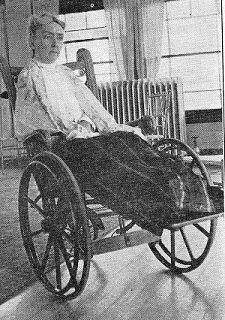
Annie Johnson Flint’s life declares the greatness of God in the midst of confusion and pain. She was orphaned as a baby. She lived in a home that bordered on poverty and spent her days as a caregiver to her adopted mother who suffered from a number of strokes. In midlife, she also fell ill and spent most of her remaining years crippled, bed-ridden, dealing with depression and chronic pain. How could God glorify Himself in all her unanswered prayers, suffering and depression? While most would look at her life and ask this question, Annie focused on all God was doing as she in the midst of every challenge she faced. She didn’t hide her pain. Instead she chose to be an encouragement to the small community around her. Because of her faith, he gave grace to her and through her life believers have sung her testimony for well over 100 years.  In one stanza her life became a wellspring of encouragement to those who face adversity, pain and the anomaly of illness:

When we have exhausted our store of endurance,

When our strength has failed ere the day is half done,

When we reach the end of our hoarded resources

Our Father’s full giving is only begun.

I think about her life and I hear this song in the middle of my own questions about suffering. I must trust the same God Annie trusted. He is enough for today’s struggles and tomorrow’s crucibles. He was enough for her. He is enough for us.